← Projects & Transformations

Independent R&D · Currently building

Active development

ALGO Research
Ecosystem

A governed, local-first system for moving from research evidence to reproducible simulation and controlled execution boundaries.

The premise

Research software should make uncertainty visible.

ALGO is designed as one ecosystem rather than three disconnected applications. Evidence, assumptions, specifications, simulation artifacts, and operating controls remain linked so that a reviewer can understand how an idea changed as it moved through the system.

Design principles

01

Evidence before implementation

Claims begin with source material and move through explicit review before they become specifications.

02

Artifacts over anecdotes

Runs retain configuration, diagnostics, and fingerprints so results can be reproduced and inspected.

03

Boundaries before autonomy

Risk, reconciliation, owner review, and readiness gates are architectural concerns—not afterthoughts.

System architecture

One traceable path from evidence to controlled output.

Each layer has a distinct responsibility and passes inspectable artifacts forward.

Research & evidence: Source material and testable claimsResearch & evidenceSource materialand testable claims01Source material and testable claimsAlgoNexus: Verify, specify, govern, and compileAlgoNexusVerify, specify,govern, compile02Verify, specify, govern, and compileAlgoSim: Simulate, model costs, diagnose, and retain artifactsAlgoSimSimulate, model costs,diagnose, keep artifacts03Simulate, model costs, diagnose, and retain artifactsAlgoHelix: Apply risk controls, reconcile state, and operate in shadow modeAlgoHelixRisk controls, reconcilestate, shadow mode04Apply risk controls, reconcile state, and operate in shadow modeControlled outputs: Reviewed specifications, diagnostics, and owner-gated artifactsControlled outputsReviewed specs andowner-gated artifacts05Reviewed specifications, diagnostics, and owner-gated artifacts
  1. Research & evidenceSource material and testable claims
  2. AlgoNexusVerify, specify, govern, and compile
  3. AlgoSimSimulate, model costs, diagnose, and retain artifacts
  4. AlgoHelixApply risk controls, reconcile state, and operate in shadow mode
  5. Controlled outputsReviewed specifications, diagnostics, and owner-gated artifacts
Conceptual workflow; it does not represent production or live-trading readiness.
01

Research layer

AlgoNexus

Turn research into governed specifications.

A research foundry for discovering source material, verifying claims, expressing assumptions, and compiling reviewable strategy specifications.

  • DiscoverOrganize research evidence and candidate ideas.
  • VerifySeparate supportable claims from unresolved assumptions.
  • SpecifyTranslate approved logic into a structured, machine-readable form.
  • GovernHold consequential transitions behind explicit review gates.
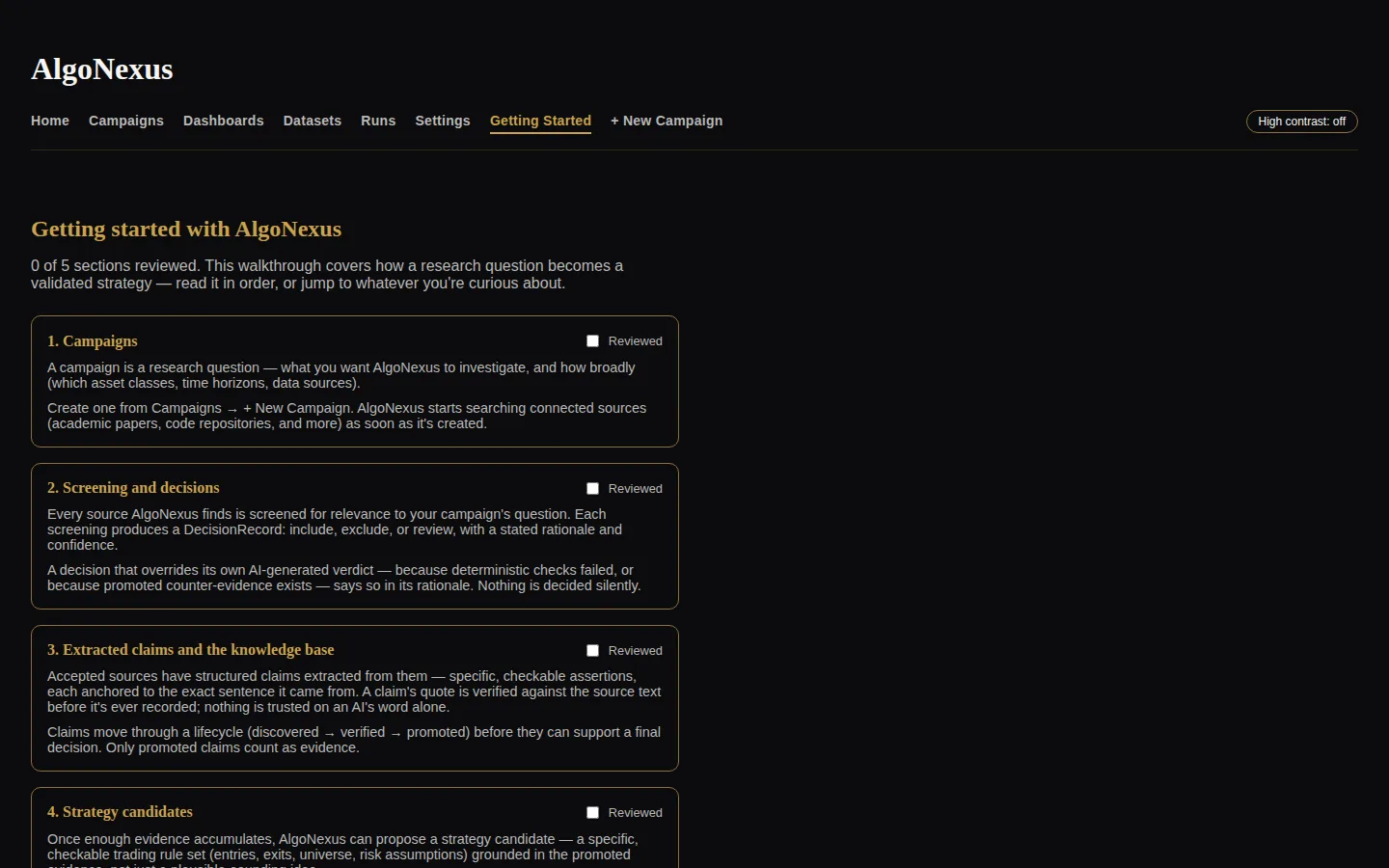
AlgoNexus getting-started page explaining campaigns, screening decisions and the claims knowledge base
Research walkthroughCampaign, screening decision, extracted claim, strategy candidate. Overrides of an AI verdict must state their reason.
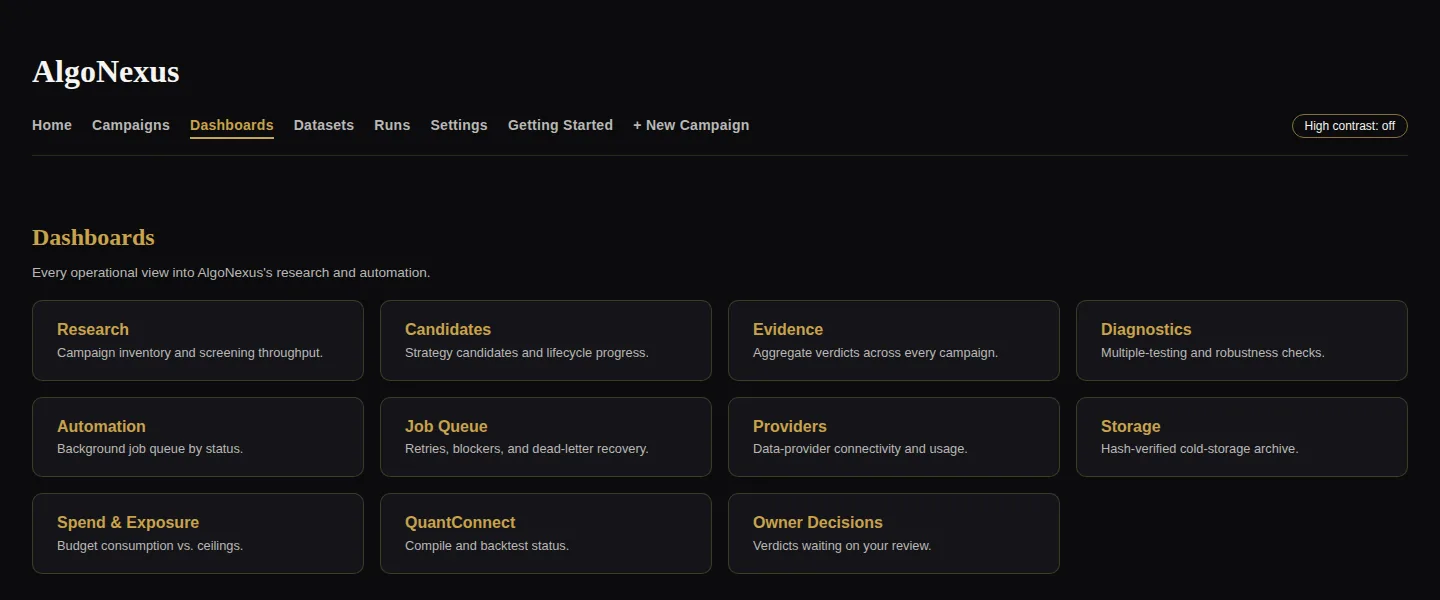
AlgoNexus dashboards index with tiles for research, candidates, evidence, diagnostics, providers and owner decisions
Operational dashboardsEvidence, diagnostics, job queue, provider connectivity, spend ceilings, and verdicts waiting on the owner.
02

Simulation layer

AlgoSim

Make testing reproducible and diagnosable.

A simulation environment that keeps data assumptions, transaction-cost logic, configuration, and diagnostic artifacts attached to each run.

Scenario discipline

Consistent inputs and configuration reduce accidental differences between comparisons.

Cost awareness

Cost modeling belongs inside the test design, not in a footnote after the result.

Retained artifacts

Run outputs and fingerprints support later review, comparison, and reproduction.
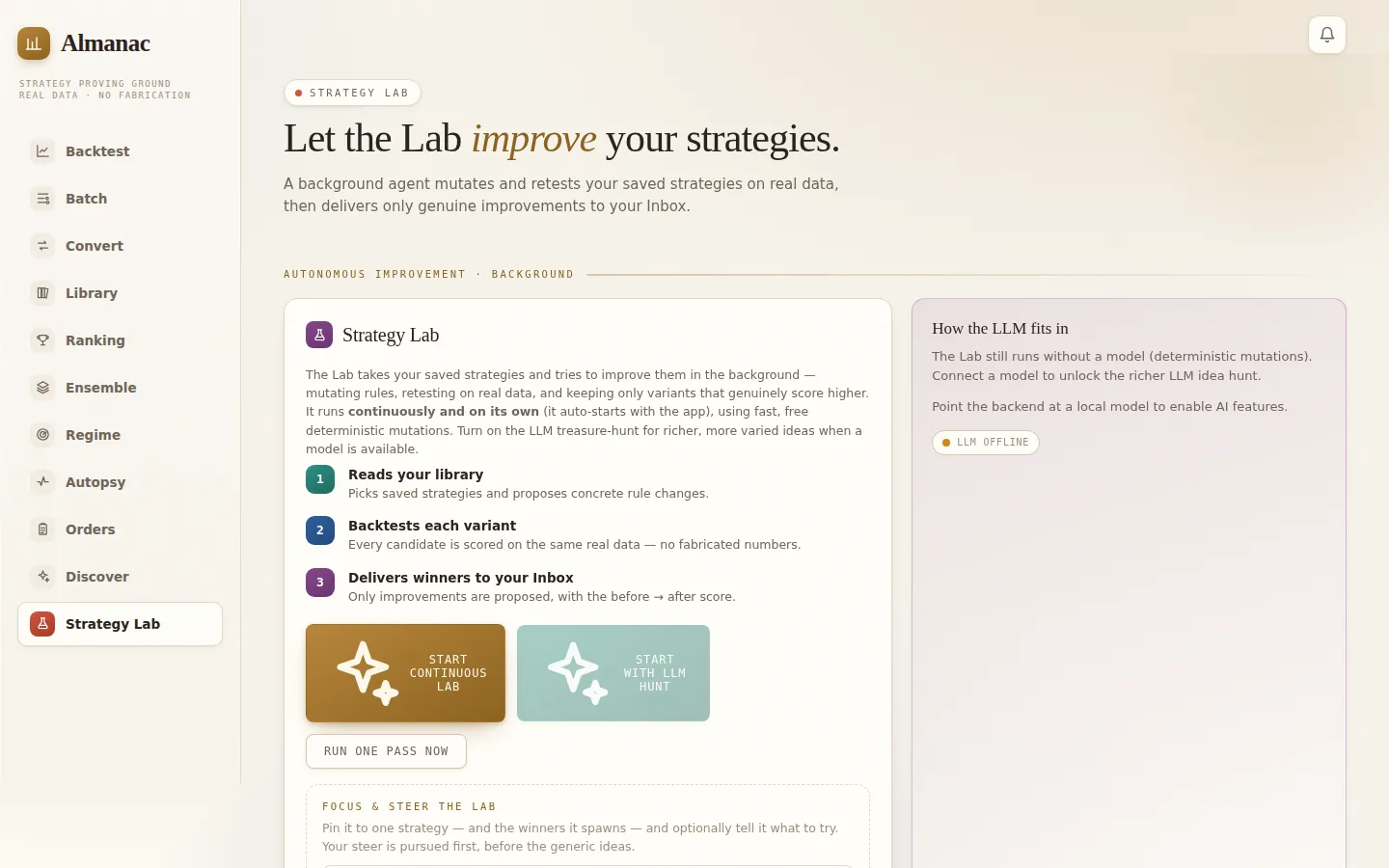
Almanac Strategy Lab screen with a three-step explanation and start controls
Companion workbench: Strategy LabAlmanac, a separate strategy-proving tool built on the same principle: real data in, honest refusals out, only genuine improvements delivered.
Almanac ensemble screen with a slider for how many strategies to blend
Companion workbench: ensemblesBlending low-correlation strategies into one book, described as historical rather than predictive.
03

Control layer

AlgoHelix

Design operating discipline before execution.

A broker-neutral control core and operator interface focused on risk policy, order-state discipline, reconciliation, readiness, and observable shadow mode.

Risk controls

Policy checks and owner-defined boundaries shape what the system may do.

State reconciliation

Expected and observed state are compared before readiness can advance.

Operator oversight

Human-readable status and gating keep consequential decisions visible.
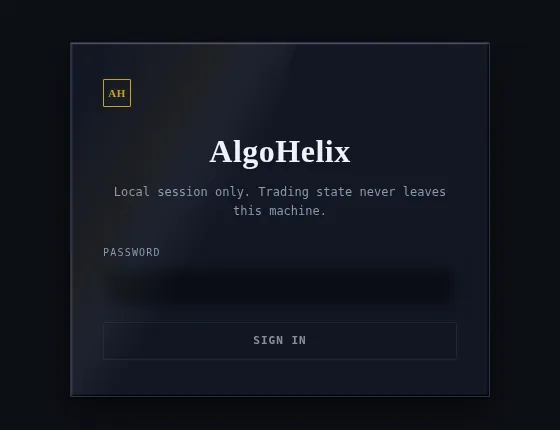
AlgoHelix sign-in panel stating that the session is local only
Local-only operator consoleA local session, with trading state that never leaves the machine. The sign-in screen only; nothing is connected.
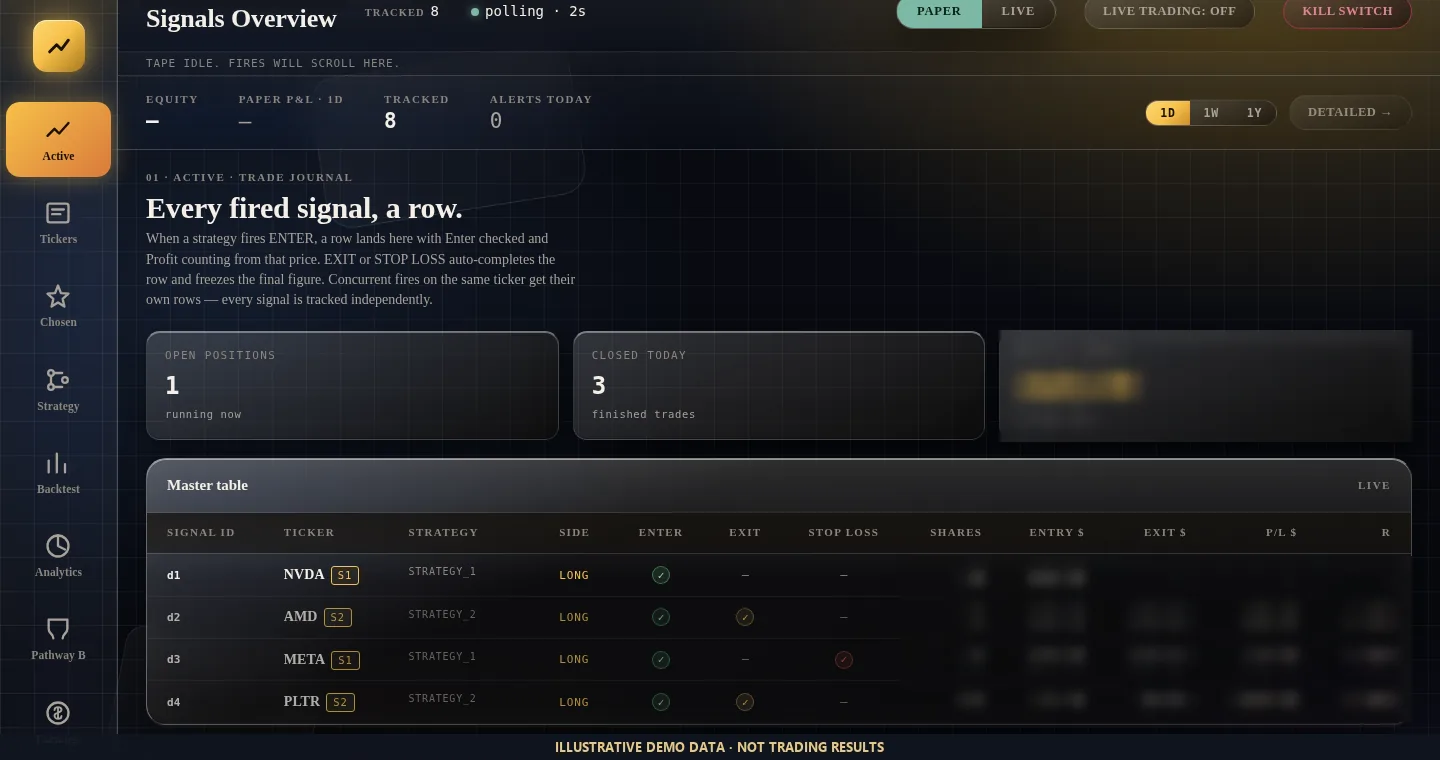
Signals paper-mode journal with open positions, closed trades and a master table whose figures are blurred
Companion monitor: paper-mode journalEvery fired signal becomes a tracked row, with the live-trading switch off. Figures are illustrative demo data and are blurred.

Audit & intelligence layer

Independent review, built into the system.

See every screen

An audit council that recommends but never enforces, and an intelligence dashboard that checks calibration and freshness before anyone relies on a signal. Review is a separate role from construction.

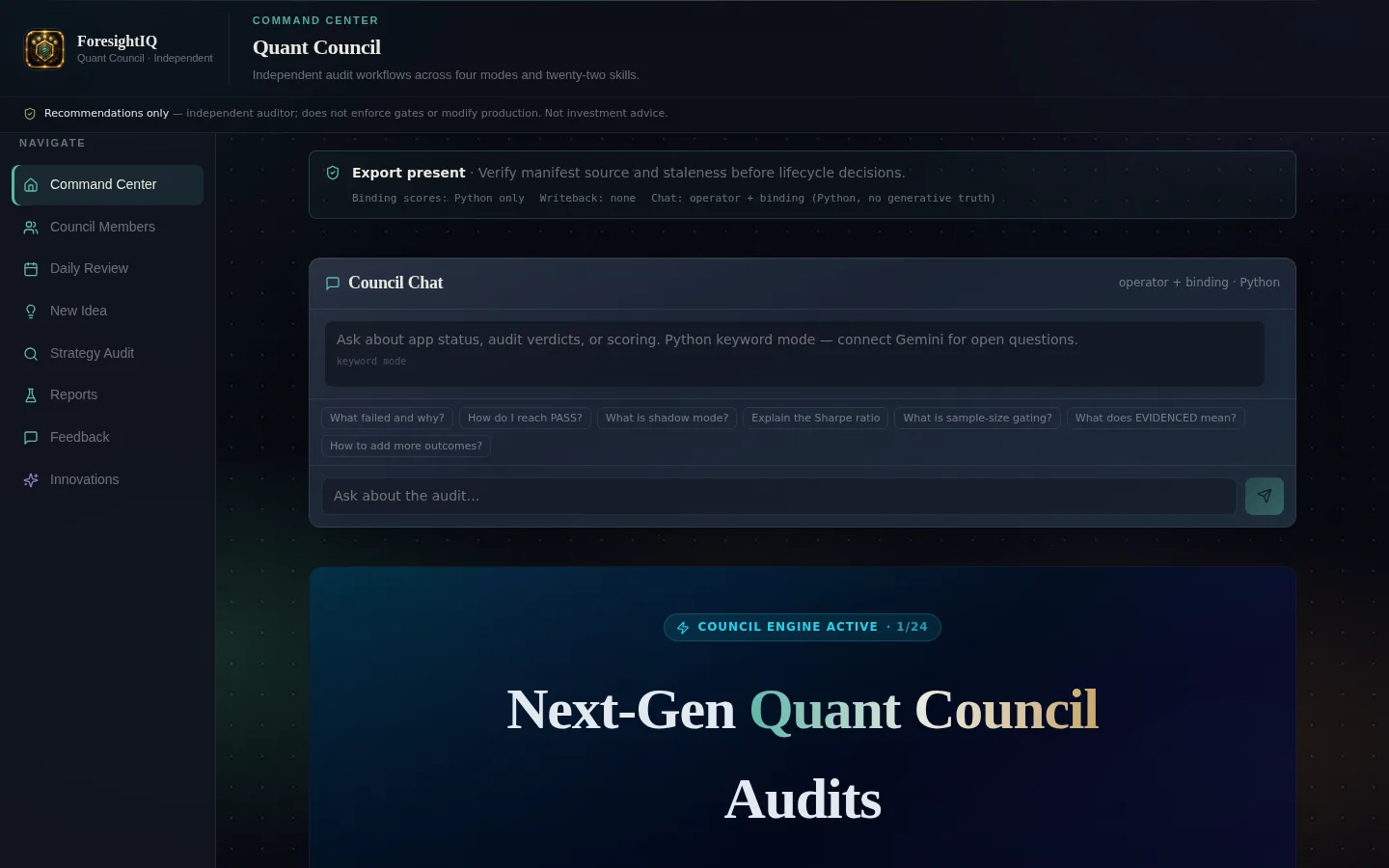
Audit council command centre with navigation, a status banner and a chat panel
Audit councilRecommendations only; it does not enforce gates or modify production.
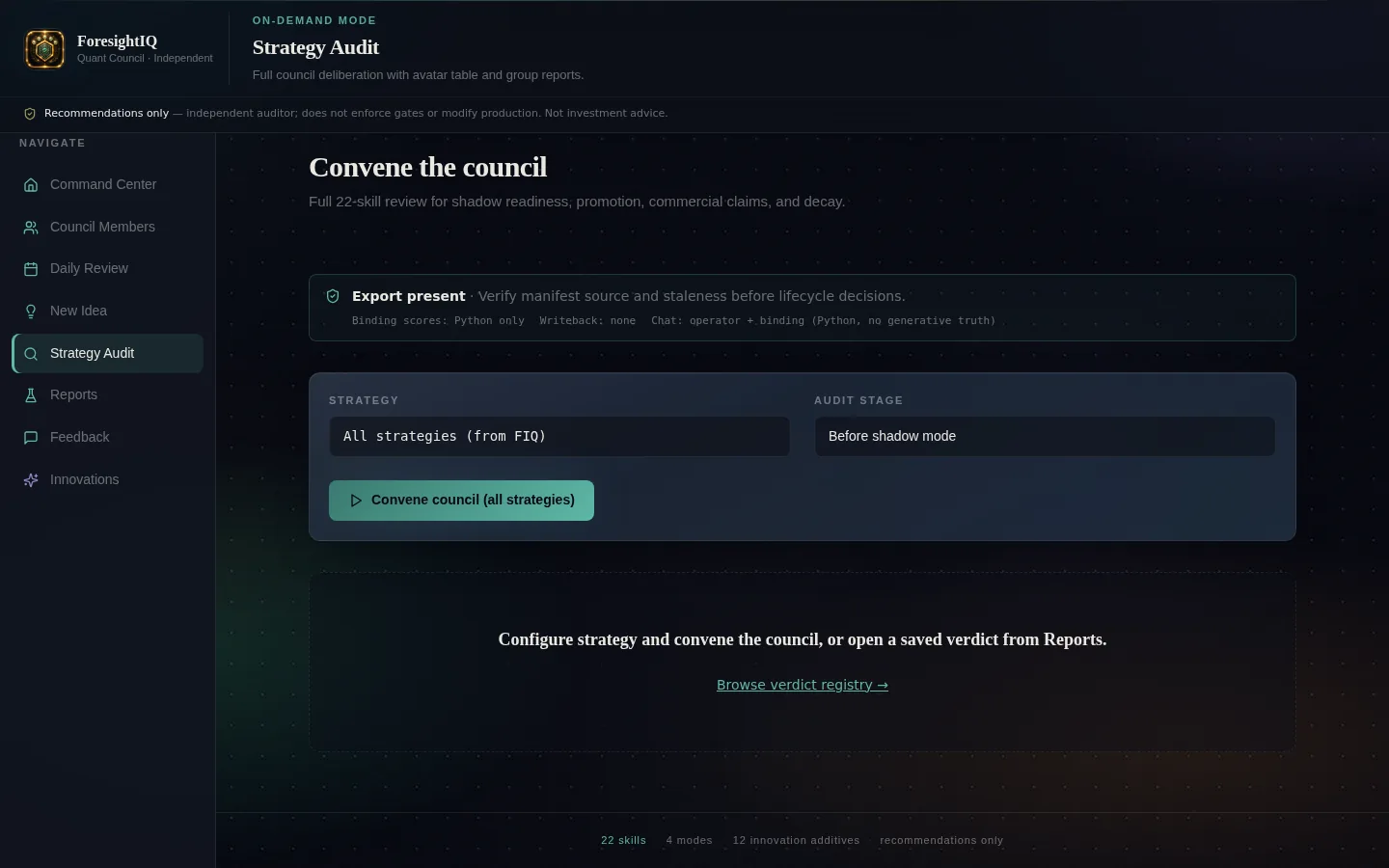
Strategy audit screen with a strategy picker, an audit stage selector and a convene button
Structured auditA twenty-two-skill review before a strategy may enter shadow mode.
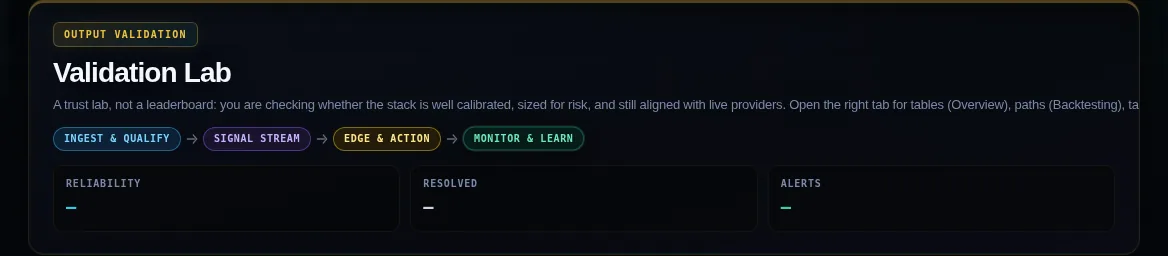
Validation Lab panel with a four-stage flow and reliability, resolved and alerts tiles
Validation labA trust lab, not a leaderboard: calibration, risk sizing and freshness.

Governance model

Progress is gated, not assumed.

ALGO distinguishes implementation from readiness. A component can exist and still require integration, review, validation, or operator approval.

Owner-required gates sit at the points where research becomes a specification and where a reviewed artifact might move toward operational use. The architecture is intentionally conservative about that distinction.

Traceability

A ledger for the research lifecycle.

Evidence

What source supports the claim?

Assumption

What remains uncertain or conditional?

Specification

What precisely is being tested?

Artifact

What can be reproduced and reviewed?

Gate

Who decides whether work advances?

Build approach

Local-first by design.

The ecosystem is being built so core research and review can operate with controlled local data paths. Services and interfaces remain modular, while the evidence chain stays legible across them.

Architecture: Python services · Structured strategy specifications · Relational and vector data · TypeScript interfaces · Content-addressed artifacts

What this case study demonstrates

Product architecture

Defining distinct responsibilities across a multi-application system.

Financial controls thinking

Applying review, reconciliation, ownership, and evidence principles to software.

Technical construction

Turning a governance model into services, interfaces, schemas, and retained artifacts.

Current status

Active development

Implemented in parts. Integration and validation continue.

This page describes the architecture and implemented direction without presenting the ecosystem as finished, production-ready, or performance-proven.

Near-term work centers on strengthening interfaces between research, simulation, and control layers; expanding repeatable validation; and keeping owner-gated review explicit.

Independent research and software development. The system is in active development, is not presented as production-ready, and does not claim or guarantee investment performance. This material is not investment advice.

A builder’s case study

Interested in the architecture behind the work?

I’m glad to discuss the product thinking, governance model, or the finance-and-technology perspective behind ALGO.

Discuss a finance leadership mandate